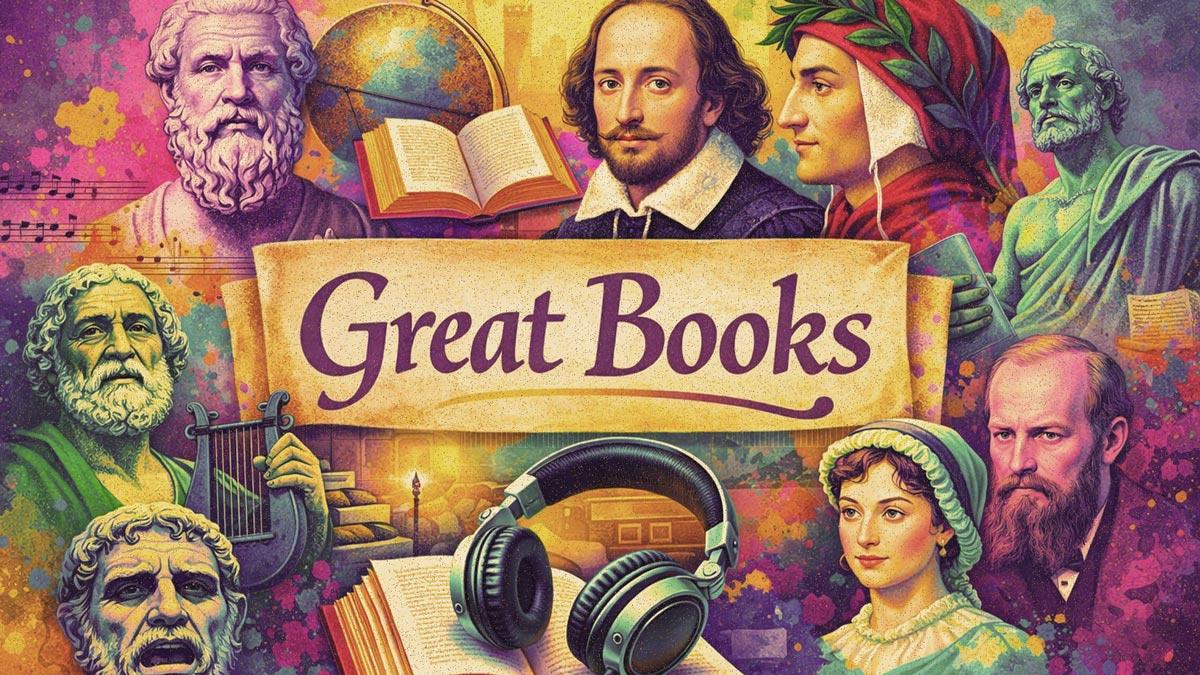
Imagine hearing hundreds of the foundational texts of Western civilization for free. It would reshape how you think, argue, perceive time, and understand human life.
Here is a complete four year program [1] of classic works in philosophy, literature, political science, psychology, history, religion, economics, math, chemistry, physics, biology, astronomy, music, language, and more. Start here to see the world through a much wider lens, and think more deliberately than most people around you.
Start Exploring the Great Books Today
Great Books — Senior Year
Now we read some of the most challenging philosophy — Hegel, Nietzsche, and Heidegger — and explore contemporary problems and interpretations of human life. Dark red = under copyright. Listen free on HearCandy.








Great Books — Junior Year
We continue with early modern science & philosophy and study the formation of modern science and political thought. Works by Galileo, Newton, Descartes, Hobbes, and Darwin, among others, helped shape modern knowledge. Listen free on HearCandy.











Great Books — Sophomore Year
In a transition to theology & medieval thought, the program focuses on Christian books and medieval authors — Virgil and Augustine, Aquinas and Dante — integrating early theology, philosophy, and literature. Listen free on HearCandy.


 66 books →











Great Books — Freshman Year
The program begins with the Greeks and the origin of disciplines — Homer’s epics, the Athenian tragedies of Aeschylus, Sophocles, and Euripides, and the founding philosophical works of Plato and Aristotle. The texts that defined what it means to ask questions in the Western tradition. Listen free on HearCandy.














Eastern Classics
A companion to the four-year Great Books program, inspired by St. John’s College’s Eastern Studies reading list — the Indian epics, Confucian and Daoist classics, Buddhist scriptures, Tang and Heian literature, Persian and Sufi mysticism. Listed in approximate chronological order. The five amber cards (Gilgamesh, Maimonides’s Guide for the Perplexed, Ibn Khaldun’s Muqaddimah, the Popol Vuh, and Things Fall Apart) stretch the definition of “Eastern” — they’re here because they’re great non-Western works that don’t fit the Western canon either. Listen free on HearCandy.




[1] This aggregation was inspired by the St. John’s College Undergraduate Reading List , including the works available in audio on LibriVox, as well as selections from the SJC Eastern Classics Program . ↩