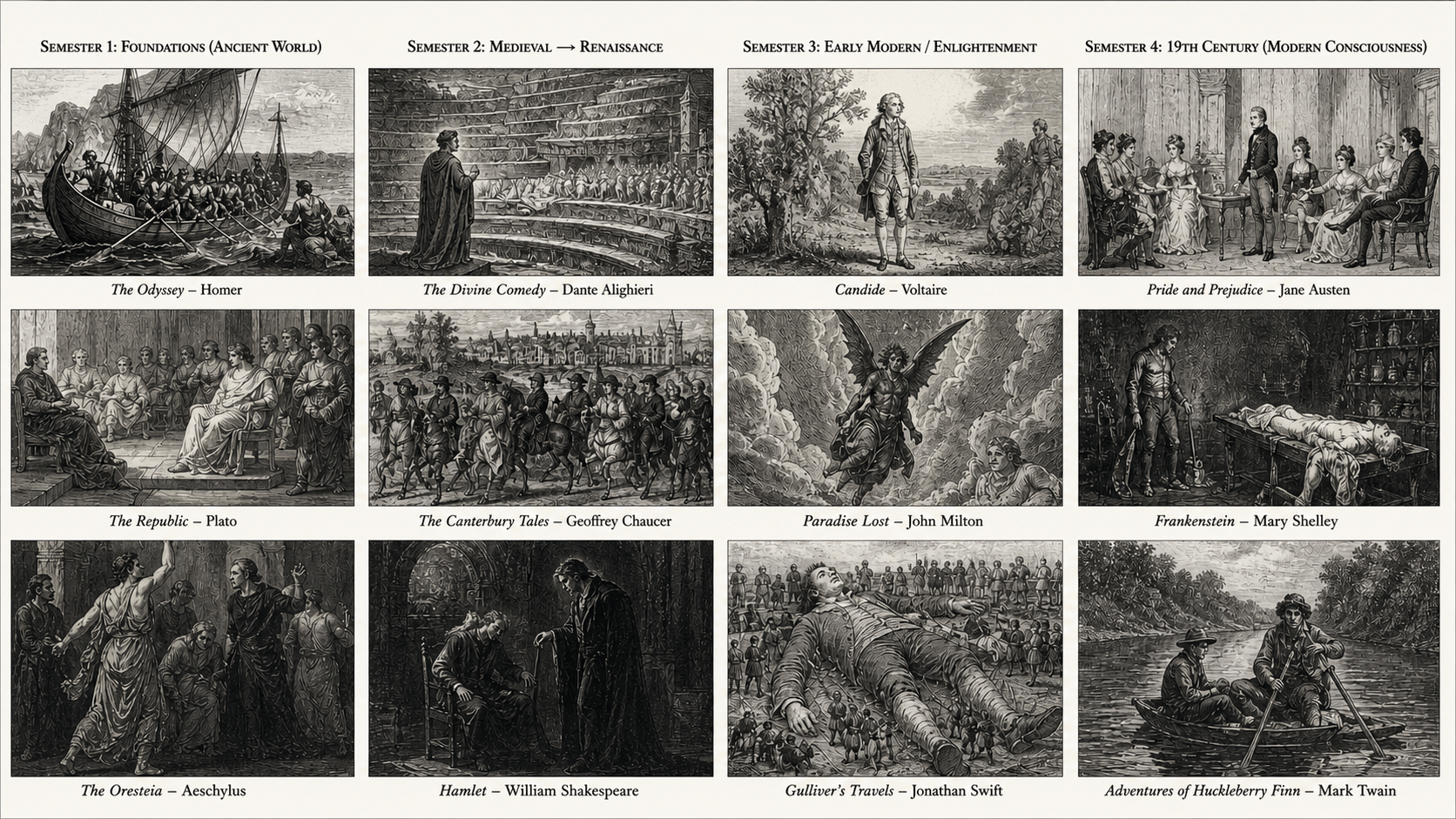
Twelve books. Two and a half thousand years. One coherent argument about what it means to be free.
This is a guided listening program through select readings in Western thought — from Homer to Swift, from Plato to Austen. Each book comes with listening notes: the context, what matters, and how to find your way in. The course is designed in four terms, one book for each month at a comfortable pace.
Read together, these works are a conversation that continues to shape how we understand freedom, responsibility, and what it means to live well.
Start the program today. All twelve audiobooks are free.
The 19th Century — Modern Consciousness
This semester focuses on the emergence of the modern individual, shaped by social pressures, technological change, and moral uncertainty. You should understand how identity, responsibility, and freedom are explored in increasingly realistic and personal terms.

A novel of manners examining social norms, marriage, and personal judgment in Regency England. Austen’s prose is deceptively light — the comedy is the vehicle for something precise and unsparing.
- The interplay between perception and reality
- Social constraints on individual choice
- Dialogue as a tool of characterization
Refines the novel as a form for examining social intelligence and moral development — and demonstrates that comedy and seriousness are not opposites.
- Pay close attention to dialogue — it carries most of the meaning
- Track changes in Elizabeth’s understanding of herself and others
- Notice the role of irony in the narration, not just the speech

Written by a nineteen-year-old in response to a ghost story contest, this is the original text of 1818 — leaner and stranger than the revised edition most people encounter. A novel exploring creation, responsibility, and the consequences of ambition unchecked by care.
- The relationship between creator and creation
- Isolation and the consequences of rejection
- The limits of scientific ambition
Anticipates modern concerns about technology, ethics, and identity with an accuracy that has only grown more striking over two centuries.
- Follow the layered narrative structure — frame within frame within frame
- Treat the creature as the central moral voice, not the monster
- Focus on responsibility rather than horror

A novel of moral growth set against the backdrop of slavery and social hypocrisy in antebellum America. Huck is an unreliable narrator who tells us more than he understands — which is the whole point.
- Huck’s evolving moral sense — and where it comes from
- The tension between society and conscience
- The use of voice and dialect as characterization
Defines the American novel as a vehicle for moral independence and critique of social norms — and does it by making you laugh the whole way through.
- Pay attention to Huck’s internal conflict — it is the novel
- Take the humor seriously
- Focus on moments of decision, especially Chapter 31
Early Modern — The Enlightenment
This semester examines the breakdown of older certainties and the rise of skepticism, satire, and individual judgment. You should see how optimism, authority, and reason are questioned — often through irony and exaggeration — as the modern world begins to take shape.

A satirical novella written at speed to attack philosophical optimism — specifically the idea, associated with Leibniz, that we live in “the best of all possible worlds.” Voltaire wrote it in response to the Lisbon earthquake of 1755, which killed tens of thousands. He was not in a forgiving mood.
- Repeated contradictions between belief and reality
- The use of exaggeration to critique ideas
- The progression of Candide’s worldview
Challenges the assumption that the world is inherently rational or just — a challenge that remains as pointed today as in 1759.
- Read quickly — the pace is the joke
- Treat repetition as intentional critique
- Focus on the ending as a statement of philosophy

An epic retelling of the fall of Satan and the fall of humanity, combining theology with remarkable psychological depth. Milton was blind when he dictated it. The result is among the most ambitious poems in any language.
- The characterization of Satan — complex, sympathetic, wrong
- The tension between freedom and obedience
- The structure of temptation and fall
Explores the nature of rebellion, authority, and moral responsibility in terms that reach far beyond their theological context.
- Focus on Books 1–4 and 9 — the rest can be sampled
- Read for argument and character, not just theology
- Notice how sympathy is constructed — and toward whom

A satirical travel narrative that begins as adventure and ends as something much darker. Swift uses scale, inversion, and impossibility to expose the absurdities of politics, science, and human nature — including the reader’s own.
- Shifting perspectives on what it means to be human
- The use of scale and inversion as argument
- The progression toward darker conclusions
Undermines Enlightenment confidence in reason and progress more thoroughly than almost any other work of the period.
- Focus on Books 1 and 4 — Lilliput and the Houyhnhnms
- Treat each voyage as a separate argument
- Pay close attention to the tone shifts — they are the point
Medieval to Renaissance
This semester explores a world structured by religious meaning, social hierarchy, and emerging individuality. You should understand how medieval cosmology gives way to more human-centered perspectives, culminating in the psychological complexity of Renaissance drama.

An epic poem describing a journey through Hell, Purgatory, and Heaven. It is possibly the most visually overwhelming work in the Western tradition — Borges said it was the most extraordinary work of literature he had ever read; T.S. Eliot restructured his understanding of poetry around it. Every soul Dante encounters reflects a complete moral and theological system, and the architecture of each realm is precise and deliberate. It is both a poem and a map.
- The moral logic governing each realm
- The relationship between sin, punishment, and justice
- The role of guidance — Virgil, then Beatrice
Encodes a complete vision of moral and cosmic order that shaped Western thought for centuries.
- Give Inferno your full attention — it is the most immediately gripping
- Purgatorio and Paradiso can be sampled freely without losing the arc
- Don’t feel obliged to decode every reference — the emotional logic carries you even when the theology escapes
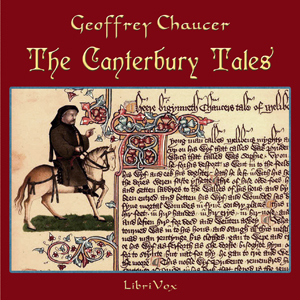
A collection of stories told by a diverse group of pilgrims traveling to Canterbury, offering a cross-section of medieval society — from knights to millers, nuns to pardoners.
- Differences in voice, class, and perspective across tellers
- Satire of social roles and institutions
- The framing device as a unifying structure
Marks a shift toward realism and individual perspective, anticipating later developments in the novel. It is also one of the funniest works in English literature.
- Read selected tales rather than the entire collection — the Knight’s, Miller’s, and Wife of Bath’s are essential
- Pay attention to tone and irony
- Notice how each tale reflects its teller

You think you already know Hamlet. That familiarity is the main obstacle. Set aside the cultural reputation — the brooding prince, the skull, the line everyone can quote — and approach it as what it actually is: a play about the paralysis of reflection, and about what happens when the capacity for thought becomes an obstacle to action.
- The tension between thinking and acting
- Questions of appearance versus reality
- The instability of identity
Represents the emergence of modern psychological self-awareness — the first great portrait of a mind watching itself think.
- Hear it as a performance, not just a text
- Focus on the key soliloquies
- Track Hamlet’s shifting state of mind across the play
Foundations — The Ancient World
This semester introduces the fundamental patterns of Western thought: the heroic individual, the structure of justice, and the origins of social order. You should come away with an understanding of how early literature and philosophy grapple with chaos, responsibility, and the possibility of a just life.

An early Greek epic rooted in oral tradition, depicting a world where human agency and divine will are intertwined.
- The contrast between cunning and strength
- The idea of “home” as identity rather than location
- Patterns of disguise, testing, and recognition
Establishes a model of the adaptable, resourceful individual navigating uncertainty — an enduring archetype in Western storytelling.
- Follow the narrative arc rather than every detail
- Treat episodes as variations on a theme
- Focus on Odysseus as a type of person, not just a character

A philosophical dialogue exploring justice, the ideal state, and the nature of the human soul.
- The evolving definitions of justice
- The parallel between the structure of the city and the soul
- The role of education and culture in shaping citizens
At the center of the dialogue is a strange and arresting claim: the structure of a just city is a mirror of the structure of a just soul. Plato’s argument is not just political — it is psychological. The Republic lays the foundation for both political philosophy and moral psychology, and its central idea — that how we organize society reflects how we are organized inside — has shaped Western thought for two millennia.
- Approach it as a conversation, not a system
- Track arguments rather than conclusions
- Notice how persuasion works within the dialogue

Three short plays — shorter than anything else this semester, listenable in an afternoon. They depict the House of Atreus: a cycle of murders and revenge that begins with a wife killing her husband on his return from Troy, continues with a son killing his mother in retribution, and ends — remarkably — with the founding of the jury trial. Athena interrupts the blood cycle and establishes a court of citizens to decide the killer’s fate. It is, in some sense, the invention of law as we know it.
We include it here instead of the Iliad because it covers different ground from the Odyssey while being far shorter, and because the transition it dramatizes — from private vengeance to civic justice — is one of the most consequential ideas in Western civilization.
- The logic of revenge and its escalation
- The shift from personal vengeance to civic law
- The role of divine authority in legitimizing justice
Represents a critical transition from tribal retribution to legal systems — one of the foundational developments of civilization.
- Focus on the overall arc rather than individual scenes
- Pay attention to emotional intensity as part of the argument
- Observe how resolution is achieved structurally