Love, Nature, Death, and the Self: Three Centuries of English-Language Poetry in Free Audiobooks
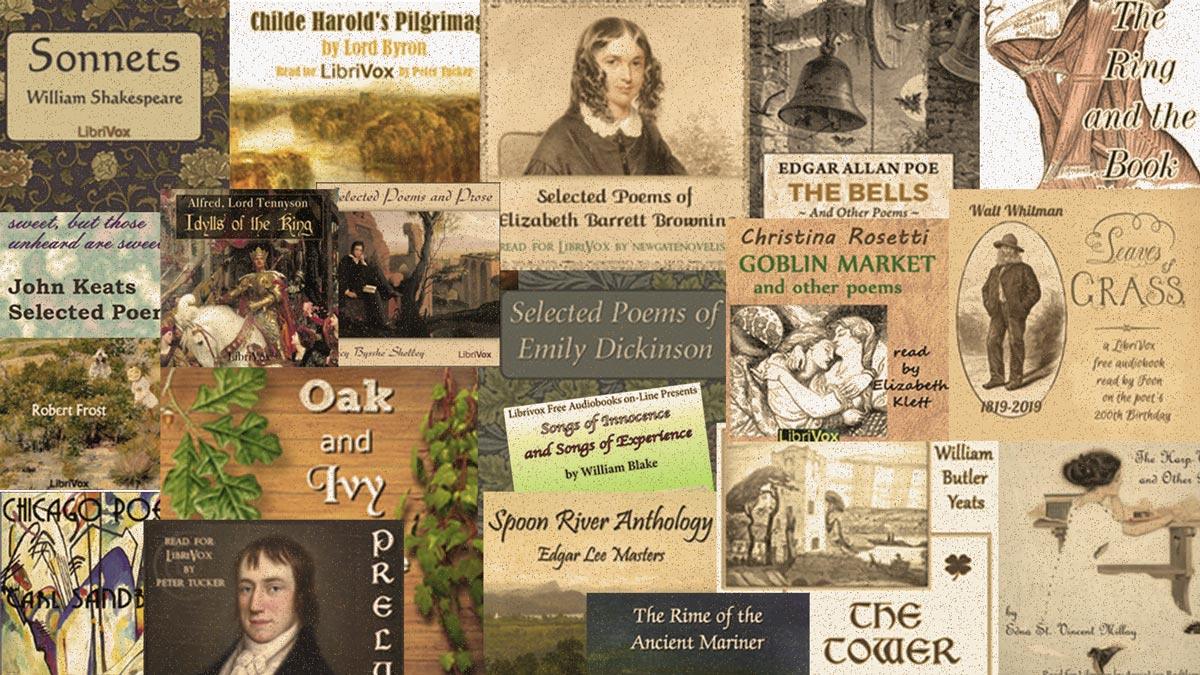
Poetry was once among the central entertainments of educated life. It was memorized, recited aloud, argued over, and carried by heart. This collection follows three centuries of English-language verse, from Shakespeare’s sonnets through the Romantics, Victorians, and early moderns. Hear how earlier generations imagined love, nature, ambition, faith, grief, beauty, and the self. Listen free on HearCandy

Shakespeare’s Sonnets
One hundred fifty-four sonnets that defined the love poem in English. The fair young man, the dark lady, and the most-quoted compressed wisdom in the language.
Listen Free →

Songs of Innocence and Experience
Blake’s twin books — the bright lambs and church bells of innocence, the chimney sweepers and tigers of experience. Two contrary states of the soul, in poems short enough to memorize.
Listen Free →

The Marriage of Heaven and Hell
Blake’s prose-poem-prophecy turning Christian doctrine inside out. “The road of excess leads to the palace of wisdom” — the manifesto of every Romantic to come.
Listen Free →

Milton: A Poem
Blake rewrites Paradise Lost as a vision in which Milton himself returns to earth to repair his own theology. The source of the hymn “Jerusalem” and one of his major prophetic books.
Listen Free →

Jerusalem: The Emanation of the Giant Albion
Blake’s longest and most ambitious work — a sprawling mythological vision in which the giant Albion (England) is restored to spiritual wholeness. Difficult, hallucinatory, unforgettable.
Listen Free →

Poems of William Blake
A representative selection across Blake’s career — including “The Tyger,” “London,” and other anthology staples.
Listen Free →

The Prelude
Wordsworth’s autobiographical epic — the growth of a poet’s mind, from childhood among the Lakes through revolutionary France. The greatest long poem in English about its own author.
Listen Free →

The Excursion
A nine-book philosophical poem on solitude, nature, and the consolations of moral life. Wordsworth’s most ambitious published work.
Listen Free →

Selection from the Sonnets
A curated set of Wordsworth’s sonnets — the form he revived and made his own, treating it as a chamber for thought rather than a vehicle for courtship.
Listen Free →

The Rime of the Ancient Mariner
An old sailor stops a wedding guest to tell a story of an albatross, a cursed voyage, and a slow return to grace. The most famous narrative poem in English.
Listen Free →

Kubla Khan
A fragment recovered from an opium dream — “In Xanadu did Kubla Khan / A stately pleasure-dome decree.” Fifty lines that have haunted the language.
Listen Free →

Frost at Midnight
Coleridge sits awake watching his sleeping infant and turns the meditation into the model for every conversation poem that followed.
Listen Free →

Childe Harold’s Pilgrimage
The autobiographical travel epic that made Byron the most famous poet in Europe overnight. Cynicism, beauty, and the prototype of the Byronic hero.
Listen Free →

Manfred
A guilt-ridden magician summons spirits to seek oblivion in the Swiss Alps. The closet drama that influenced Nietzsche and named a Tchaikovsky symphony.
Listen Free →

The Corsair
A pirate-captain epic in heroic couplets — Byron’s biggest popular hit, selling ten thousand copies on its first day of publication.
Listen Free →

The Giaour
A fragmented Turkish tale — vampires, vengeance, lost love — and the introduction of “Giaour” (infidel) to English readers.
Listen Free →

Selected Poems and Prose
The widest entry into Shelley’s work: lyrics, odes, philosophical fragments, and prose. Includes “Ode to the West Wind,” “To a Skylark,” and “Mont Blanc.”
Listen Free →

Queen Mab
Shelley’s early atheist epic in nine cantos — the fairy queen Mab shows a sleeping girl visions of human history, present injustice, and future utopia. Got him expelled and disowned.
Listen Free →

The Cenci
A tragedy in blank verse based on the 16th-century murder of the tyrannical Count Cenci by his own children. Shelley’s nearest approach to playable theater.
Listen Free →

The Masque of Anarchy
A poem of nonviolent protest written after the Peterloo Massacre — “Rise like Lions after slumber.” A founding text of nonviolent resistance literature.
Listen Free →

Poems
Selected works by England’s great peasant poet — close-observed nature, the lost commons, asylum lyrics. A century of being underrated.
Listen Free →

To the Rural Muse and Other Poems
Clare’s 1835 collection, written in the years before his asylum confinement — pastoral, exact, deeply rooted in Northamptonshire.
Listen Free →

Selected Poems
The canonical short list: the great odes (“Nightingale,” “Grecian Urn,” “Autumn”), “La Belle Dame sans Merci,” “Bright star.” Everything Keats wrote in his last three years before dying at twenty-five.
Listen Free →

Poems 1817
Keats’s first published book — apprentice work, but already containing “I stood tip-toe upon a little hill” and “Sleep and Poetry.” The poet finding his voice.
Listen Free →

Selected Poems
A representative selection of EBB’s range — the political verse, the sonnets, the dramatic monologues, and the famous “How do I love thee?”
Listen Free →

Sonnets from the Portuguese
Forty-four love sonnets written privately for Robert Browning during their courtship. The most famous English sonnet sequence after Shakespeare.
Listen Free →

Runaway Slave at Pilgrim’s Point
An abolitionist dramatic monologue — a fugitive woman speaks from the rock the Pilgrims landed on. Among the most powerful protest poems of the era.
Listen Free →

Edgar Allan Poe Poems
Selected verse: “The Raven,” “Annabel Lee,” “The Bells,” “Lenore.” Sound-obsessed, hypnotic, the foundation of American Symbolism.
Listen Free →

The Bells and Other Poems
Poe’s onomatopoeic masterpiece plus a wider selection — the late poems where his rhythmic experiments became inescapable.
Listen Free →

The Raven and Other Poems
Poe’s most famous poem plus selected lyrics. “Once upon a midnight dreary, while I pondered, weak and weary…”
Listen Free →

Miscellaneous Poe: Poems and Short Stories
A mixed entry — poems alongside the prose tales Poe is equally remembered for. “The Tell-Tale Heart,” “The Cask of Amontillado,” and the verse that haunted them.
Listen Free →

Idylls of the King
Tennyson’s twelve-book Arthurian cycle — the Round Table from formation to ruin. A Victorian elegy for ideals that no longer hold.
Listen Free →

In Memoriam A.H.H.
One hundred thirty-three lyrics, written over seventeen years, mourning Tennyson’s friend Arthur Hallam. The greatest English elegy and a private record of faith wrestled into existence.
Listen Free →

The Princess
A medley about a women’s university — comic, lyrical, full of embedded songs (“Tears, idle tears”; “Sweet and low”). Less famous than In Memoriam but more inventive.
Listen Free →

Maud, and Other Poems
A monodrama in fragments — love, madness, and the Crimean War seen through a single deranged narrator. Tennyson called it his favorite.
Listen Free →

Robert Browning 200th Anniversary Collection
A curated selection covering Browning’s range — dramatic monologues, lyrics, late philosophical poems. The simplest entry to a famously difficult poet.
Listen Free →

The Ring and the Book
Twelve interlocking dramatic monologues retelling a single 1698 Roman murder trial from ten different angles. Browning’s epic — twenty thousand lines, his most ambitious work.
Listen Free →

Pippa Passes
A young factory girl walks through town singing — and her songs alter the lives of strangers she never sees. Includes the line “God’s in his heaven — / All’s right with the world.”
Listen Free →

Leaves of Grass
The book Whitman rewrote and expanded for forty years — “Song of Myself,” “I Sing the Body Electric,” “When Lilacs Last in the Dooryard Bloom’d.” The founding text of American free verse.
Listen Free →

Goblin Market and Other Poems
The title poem — two sisters tempted by goblin fruit — is the most unsettling Victorian fairy tale ever written. Plus “Up-Hill,” “Remember,” “In the Bleak Midwinter.”
Listen Free →

Poems: Series One
The first posthumous collection — heavily edited, but the first time the world saw “Because I could not stop for Death” and “I’m Nobody! Who are you?”
Listen Free →

Poems: Series Two
A second posthumous gathering — more nature lyrics, more death poems, more of the compressed metaphysics that made her unique.
Listen Free →

Poems: Third Series
The last of the early Higginson/Todd editions — many of the love poems and friendship lyrics first appeared here.
Listen Free →

Selected Poems of Emily Dickinson
A compact entry into Dickinson’s nearly 1,800 poems — the indispensable handful.
Listen Free →

Poems of Gerard Manley Hopkins
Hopkins died in 1889 unpublished; his Jesuit superiors thought his sprung-rhythm experiments incomprehensible. When the poems finally appeared in 1918, they sounded thirty years ahead of their time.
Listen Free →

The Wild Swans at Coole
Yeats in middle age — “Easter, 1916,” “The Second Coming,” and the title poem about the swans he had counted for nineteen autumns at Coole Park.
Listen Free →

The Wind Among the Reeds
Yeats at his most ornate Celtic-twilight phase — “He Wishes for the Cloths of Heaven,” “The Song of Wandering Aengus.”
Listen Free →

The Tower
Yeats at his most masterful — “Sailing to Byzantium,” “Leda and the Swan,” “Among School Children.” His greatest single volume.
Listen Free →

Responsibilities
Yeats’s transitional volume — abandoning the dreamy Celtic mood for harder, public, modern verse.
Listen Free →

Spoon River Anthology
Two hundred forty-four epitaphs spoken by the dead of a small Illinois town — each ghost telling the truth they couldn’t tell while alive. A landmark of American free verse.
Listen Free →

The Black Riders and Other Lines
Crane’s stark, parable-like poems — predating Imagism by a decade. Compressed, bitter, philosophically alone.
Listen Free →

Oak and Ivy
Dunbar’s 1893 debut — printed at his own expense — combining standard English lyrics with the dialect poems that made his name. The first major book of poetry by an African American to win a national audience.
Listen Free →

North of Boston
The book that made Frost — “Mending Wall,” “The Death of the Hired Man,” “Home Burial.” Conversation-poems that look like rural sketches and turn metaphysical.
Listen Free →

A Boy’s Will
Frost’s first book — quieter, more lyrical than what followed, but already recognizably him.
Listen Free →

Mountain Interval
Includes “The Road Not Taken,” “Birches,” “Out, Out—.” The middle of Frost’s great early run.
Listen Free →

New Hampshire
The volume that won Frost the first of his four Pulitzers. “Stopping by Woods on a Snowy Evening,” “Fire and Ice,” “Nothing Gold Can Stay.”
Listen Free →

Selected Poems
A career-spanning selection — the easiest way in if you only want one Frost volume.
Listen Free →

Chicago Poems
The book that made Sandburg — “Hog Butcher for the World, / Tool Maker, Stacker of Wheat.” American free verse made out of slang and street sound.
Listen Free →

Cornhuskers
Sandburg’s second book, sharing the 1919 Pulitzer — moving from the city to the prairie, but the voice unchanged.
Listen Free →

Slabs of the Sunburnt West
Sandburg in his maturity — the West, the railroads, and a long title poem about the dry country and what it takes from those who live there.
Listen Free →

Love Songs
The book that won the first Columbia Poetry Prize (later the Pulitzer) — lyric poetry stripped to its essence.
Listen Free →

Flame and Shadow
Teasdale’s mature collection — quieter, more elegiac, her voice darkening before the end.
Listen Free →

Rivers to the Sea
The book that established Teasdale — short lyrics with the polish of song and the directness of speech.
Listen Free →

Helen of Troy and Other Poems
Teasdale’s second book — dramatic monologues alongside the lyrics, including the title poem in Helen’s voice.
Listen Free →

Renascence and Other Poems
Millay’s first book, including the title poem she wrote at nineteen — a vision-of-rebirth poem that announced an extraordinary voice.
Listen Free →

Second April
Millay in her early twenties — “What lips my lips have kissed,” “Spring,” “The Poet and His Book.” Skill at full flame.
Listen Free →

The Harp-Weaver, and Other Poems
The book that won Millay the Pulitzer — at thirty-one, she was the third woman to win it.
Listen Free →

Poems
A career-overview collection — Millay’s sonnets, ballads, and the later poems that grew political.
Listen Free →